

Early Specification of Protective Buildings Pays Off: Why Blast-Resistant Buildings Should Be Addressed Before FEED
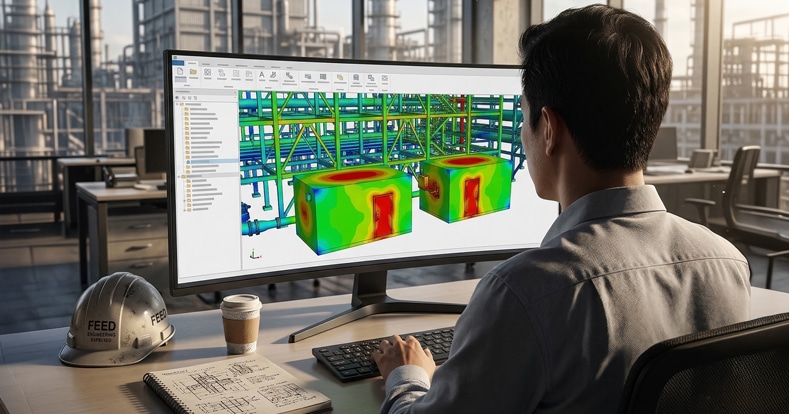
Many capital projects get protective buildings wrong. Not by choosing the wrong building, but by choosing the right one too late.
When blast-resistant and multi-hazard buildings aren’t addressed during the concept and feasibility stages of a capital project, they often become problems during detailed engineering or EPC execution. By that point, site layout is already being finalized, foundation assumptions are set, underground utilities are routed, and separation distances are harder to change. A building that should have been part of the design basis becomes a costly change order, a lengthy schedule issue, and a project decision nobody wanted.
There is a better way to approach it, and it starts earlier than most project teams think.
What Gets Decided Before FEED
Front End Engineering Design (FEED) is the stage where scope, layout, and key design assumptions are defined sufficiently to support execution planning. Process flow diagrams are established, equipment specifications are developed, and scheduling is mapped across engineering, procurement, and construction (EPC) execution. Essentially, it is the stage that translates engineering design into something a construction team can build.
However, before FEED is the concept and feasibility stages, which is when the general facility concept is developed and initial cost estimates are performed. It is in these stages that facility siting should first happen to determine the facility hazard profile which provides the information necessary to identify This is also the stage where the protective building specifications get written based on the developed hazard profile. This specification then becomes the document that FEED teams will actually bid on and engineer against. If facility siting isn’t completed and protective building specifications aren’t developed until FEED is already underway, the project enters execution with place holder costs and design parameters, which often aren’t representative of the actual needs.
This is where a trusted partner with deep experience in both the feasibility analysis and the construction of protective buildings becomes essential. A firm that understands how the building interacts with process hazards, site layout, and the capital project lifecycle will catch the problems that drive late-phase cost and schedule impacts. Engaging blast-resistant and multi-hazard buildings expertise at the concept and feasibility stages, before the design locks in, is the decision that changes the project’s trajectory.
Three Ways Late Specification Damages Projects
There is nothing abstract about what happens when protective buildings are not scoped early. Research and industry experience consistently show that it damages projects in three very specific, interconnected ways:
Costly Redesigns Mid-Project
Here is what actually happens: A blast-resistant building is scoped for a specific location, let’s call it Spot X. Later in the project, when a facility siting study or consequence analysis is finally conducted, the results show that Spot X doesn’t meet the required separation distances or hazard exposure criteria for that type of building construction.
Now the project team faces a hard choice. Move the building to Spot Y–a different location that meets the hazard criteria for that construction type`–and redo all the foundations, utilities, and infrastructure that were already designed and sometimes already procured for Spot X. Or redesign the building entirely for Spot X to meet the hazard loads that weren’t characterized until late in the project. Either path means rework and more money.
Schedule Delays That Ripple Across the Program
The schedule impact isn’t just the time it takes to move a building. When a late-identified problem forces a redesign, the design process starts over. And that redesign spans every trade connected to it: Utilities serving that building, foundation work, HVAC components, blast-rated door and window assemblies, and structural elements.
While the new design is being developed, procurement on building related infrastructure has to wait, which hurts. Protective building component lead times can run several months. Even once the revised design is complete, the project sits and waits for materials. In a business where idle facility days carry real dollar costs, the schedule impact of a late protective building specification is almost always larger than the cost of the building itself.
Compliance Gaps Discovered Late
Standards such as API RP 752 and 753 set clear requirements for how occupied buildings should be sited and designed in relation to process hazards. These standards establish the framework for facility siting studies (FSS) and quantitative risk assessments (QRA) that determine whether a building’s location and design are defensible.
When those requirements are not addressed during concept and feasibility, they surface during operations facility siting studies, resulting in costly changes early in the facility lifecycle. Specifying to a standard at the concept gate means compliance is part of the design from the beginning. Discovering compliance gaps during final review means fixing them under pressure, on a compressed timeline, with a full EPC team standing by.
Blast Resistance Is the Starting Point
Blast resistance gets the most attention in project safety conversations for good reason. It is the most publicly visible hazard in the industrial space, and historically, the one that has driven the most significant loss events.
But specifying a blast-resistant building and considering the job done is no longer an adequate approach to protective building design. In fact, many late-project changes resulting from protective building gaps can be directly tied to a focus only on blast resistance, without accounting for the facility’s full hazard profile from the start.
The hazard environment inside a refinery, petrochemical plant, or LNG facility is not a single-threat environment:
- Fire events
- Toxic gas releases from loss of containment events
- Fragmentation from equipment failures and explosion secondary effects
- Extreme weather
Each of these hazards presents distinct risks to occupants and each demands specific engineering. And critically, each of them is better addressed during the concept phase, when the hazard profile is first defined.
When consequence modeling and facility siting work occur at the concept and feasibility stages, project teams can identify not just overpressurecontours but also thermal radiation contours, toxic dispersion footprints, and flammable limit boundaries, all of which affect where a building can safely sit and what it needs to withstand. This is the work that prevents the Spot X vs. Spot Y problem from happening in the first place.
When the hazard profile is defined early, and the building is specified at FEED, there is room to engineer a structure with blast resistance, thermal barriers, filtered-air and positive-pressure systems, and structural robustness against fragmentation and wind loading as a single, integrated solution. When that work gets pushed to detailed design, the options significantly shrink.
FORTRESS in the Concept Phase
FORTRESS designs and builds multi-hazard protective buildings for refineries, LNG facilities, petrochemical plants, and other high-consequence industrial environments. The buildings we deliver protect people from blast, thermal events, toxic releases, fragmentation, and extreme weather, within a single engineered structure.
FORTRESS supports owners and EPC teams during concept and feasibility and FEED by helping define hazard design criteria, performance requirements, and specification-ready documentation. That means the building specification that enters FEED has already been developed with the facility’s actual hazard profile in mind.
And FORTRESS stays engaged through detailed engineering and construction, ensuring you get the protection you actually need with no surprises throughout the project lifecycle.
Protective buildings specified early are a project advantage. Protective buildings specified late are a project problem. The hazard environment at your facility doesn’t wait for your schedule, but with the right partner engaged at the right phase, your schedule doesn’t have to wait for it either.
Contact Us
For questions, detailed discussions or consultations, feel free to reach out to us. We value your safety and security as much as you do.
CONTACT US