

Navigating Organizational Silos for Successful Projects
Navigating Organizational Silos for Successful Projects
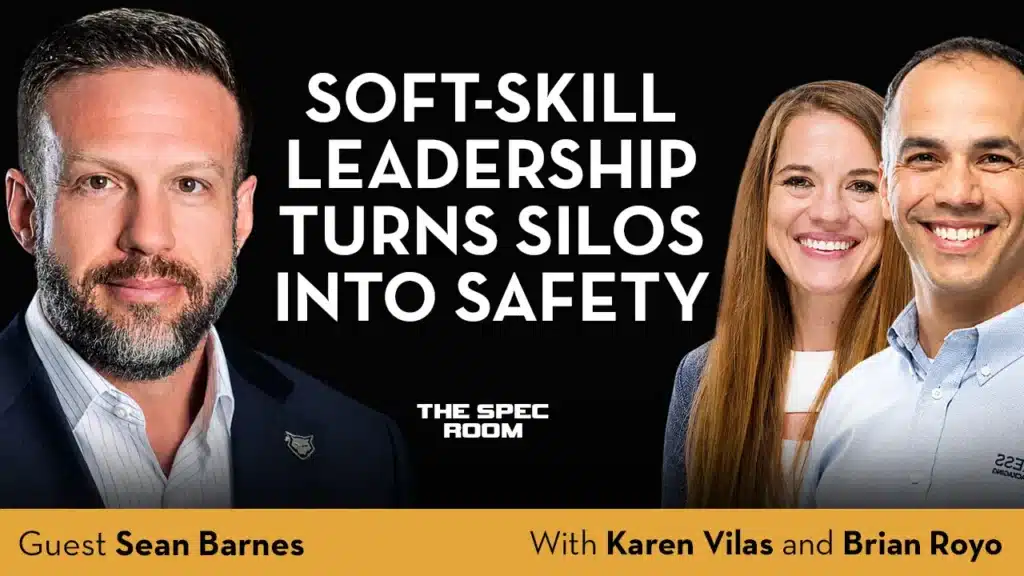
In this episode of The Spec Room Podcast, co-hosts Karen Vilas, CEO of BakerRisk and FORTRESS Protective Buildings, and Brian Royo, President and Director of Operations at FORTRESS, sit down with Sean Barnes, CEO of Wolf Executives, keynote speaker, and advisory council member at Energy Conference Network. The conversation focused on how organizations accidentally build the very silos they’re trying to avoid, and what it actually takes to get people talking across them.
Silos Are a Byproduct of Good Intentions
Brian opens with a confession many growing companies will recognize. As FORTRESS works through lessons learned from past projects, each one tends to produce a new process or procedure. A quality issue leads to a quality process. A scheduling issue leads to a scheduling process. Repeat that enough times, and a small company can end up with the same fragmented departments that plague large EPC firms. Each one was created with good intentions, but each one became increasingly disconnected from the others.
Sean reframes the goal in a way that shapes the rest of the episode. The answer isn’t to tear the silos down. Organizations need that depth of expertise to manage risk well. The real goal is making the walls between silos porous, so communication can move through them instead of stopping at the edge.
Communication or misaligned incentives?
Karen pushes on a sharper question early in the conversation: Is the real problem communication, or is it that different teams are simply rewarded for different things? Sean agrees that incentives matter. Engineers are typically judged on accuracy, finance on the numbers, and those measures of success rarely line up naturally. But he argues the fix still runs through communication. Teams have to be willing to say what their priorities are and ask what the other side’s priorities look like before any real alignment is possible.
Brian adds a practical layer to this. Sometimes the disconnect isn’t incentives at all. Sometimes it’s vocabulary. She points to a real example inside FORTRESS, where the word “profit” means something different to an engineer than it does to accounting. Sean’s advice is to build in intentional upskilling so each group can speak enough of the other’s language to actually hear each other, and to walk into another team’s meeting with humility, naming upfront that you may not know the right terms rather than assuming your own language will translate.
Cross-pollination beats org charts
One of the more concrete ideas in the episode is what Sean calls cross-pollination of knowledge, deliberately rotating people through meetings and functions outside their own lane, even if only briefly.
He describes doing this himself early in his career, sitting in on HR and safety meetings before he formally led those teams, sometimes getting asked why he was even there. Over time, that exposure let him understand those domains instead of just managing them from a distance. For a growing company without the bench depth of a Halliburton or Schlumberger, Sean’s point is that this has to be intentional. Nobody accidentally finds time to upskill in this way.
Losing sight of the actual goal
The conversation turns pointed when Brian brings it back to protective building projects specifically. A large EPC has procurement, schedulers, quality teams, and engineers, each measured against their own targets. But as Brian puts it, none of those targets were ever the actual goal. The goal was protecting people’s lives. That’s precisely where things break down. A facility siting study gets issued, a recommendation gets made, and then it can sit untouched for years until BakerRisk is called back to find the building no longer meets the standard it was supposed to meet.
Sean’s response is that this is exactly why an organization needs a layer with real oversight into every silo. One with enough understanding of each domain to recognize when something is breaking down and intervene early, rather than letting frustration escalate up the management chain until it becomes a top-down mandate.
Setting the tone from day one
Brian shares his own approach for keeping a protective building project aligned with its real purpose. He explains pushing owners early to clarify whether a facility siting study is a genuine commitment to protecting people, or simply a checkbox. From there, he brings in process safety, operations, and the contractors who will actually do the work, all reviewing the same report together before pricing ever begins. Sean calls this the right instinct, adding that vetting the “right people” for a project is vital.
Personality is part of the silo problem too
Later in the conversation, Sean introduces behavioral style, a layer that goes beyond process. Drawing on frameworks like DISC and the Enneagram, he explains that HR professionals, engineers, and finance teams often cluster into different personality patterns, and that friction between silos is sometimes as much about communication style as it is about incentives or terminology. Brian shares that FORTRESS has run its own team through Enneagram assessments, giving people language to understand not just what a colleague is saying, but how they’re wired to say it.
Listen and Subscribe
If this conversation changed how you think about your next protective building project, that’s the whole point. Learn more at https://info.fortressprotectivebuildings.com/specroom, and follow The Spec Room Podcast for more conversations on breaking down the silos that put projects and people at risk.
Watch or listen: